
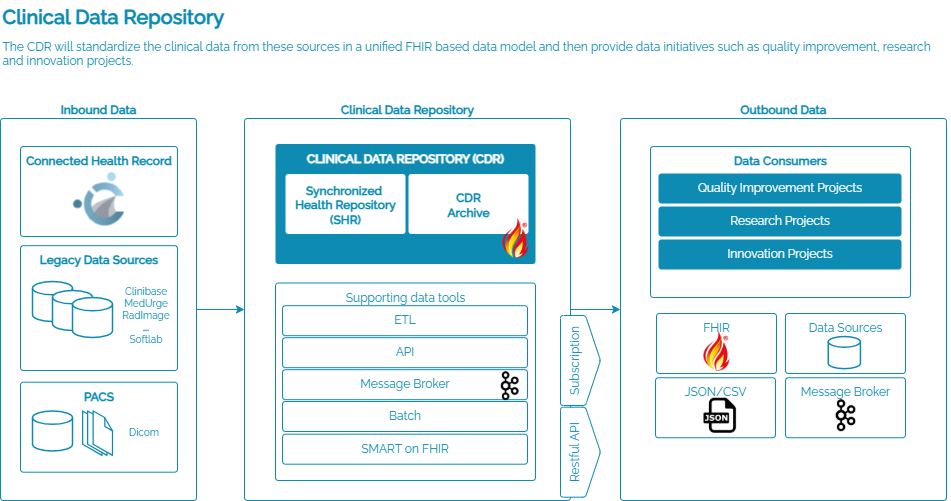
A Clinical Data Repository (CDR) collects clinical data such as demographics, laboratory results, radiology images, admissions, transfers, and diagnoses from various clinical sources like the Connected Health Record and the current generation electronic medical records or laboratory systems in use now to provide a full picture of the clinical data reflecting the care a patient has received. The CDR will standardize the clinical data from these sources in a unified FHIR based data model and then provide data, under proper security, privacy, and confidentiality frameworks, in a much more efficient way for these use-cases. The CDR provides a single source of truth of clinical data to drive operational and research initiatives.
FHIR (Fast Healthcare Interoperability Resources) is a widely adopted standard for healthcare data exchange, developed by HL7 (Health Level Seven International). It was created to simplify the sharing of healthcare information between different systems, enabling faster, more efficient, and standardized data interoperability. FHIR combines the best features of previous healthcare data standards (such as HL7 v2 and CDA) with modern web technologies, making it easier for developers to build and integrate healthcare applications.
At its core, FHIR represents healthcare data as Resources, which are modular components like patient records, lab results, and clinical observations. These resources can be exchanged between systems via APIs, making FHIR adaptable to various use cases, from large hospital systems to mobile health apps. SmileCDR, a robust platform for managing FHIR data, leverages this standard to enable seamless access and consumption of healthcare data across different stakeholders.
The Connected Health Record (CHR) is the new electronic health record for the Centre-Ouest-de-l’Île-de-Montréal (CIUSSS) that will provide a unified digital patient health record. The CHR will replace many of the clinical software platforms currently in use. CDR unifies the clinical data from the Jewish General Hospital (JGH) current systems (which will in the future be decommissioned, thus this data will be known as CDR Archive) as well as the future and ongoing data generated from the Connected Health Record, once launched in late 2025.
When accessing data from the CDR, it is essential to ensure that data access is aligned with the specific needs of each project. The scope of data is restricted based on the requirements and objectives of the individual project, adhering to data governance policies and privacy regulations. This ensures that only relevant data is accessed and shared, minimizing the risk of overexposure and ensuring compliance with ethical and legal standards. Researchers, management, and clinical operations teams can consume data from a Clinical Data Repository (CDR) through file-based access or subscription-based delivery.
Our consultancy, offered as part of the Information Management Systems (IMS), provides strategic and technical guidance on data management and integration. We help implement tailored solutions for your data projects, with expertise such as system architecture and FHIR interoperability.
As part of our services, our team collaborates closely with your project team to develop custom data connectors tailored to your project needs. These connectors can be implemented, to retrieve data from the CDR, for example, based on message queuing or bulk data extraction to enable data transfer to your file server, repository, or other storage solutions.
Business Hours
Monday-Friday from 9:00 am to 5:00 pm
The LDI IT Help Desk can be contacted:
FHIR: Fast Healthcare Interoperability Resources
For more information consult: https://hl7.org/fhir/R4/index.html